Reading the Grain: How to Judge Solid Wood Before You Buy
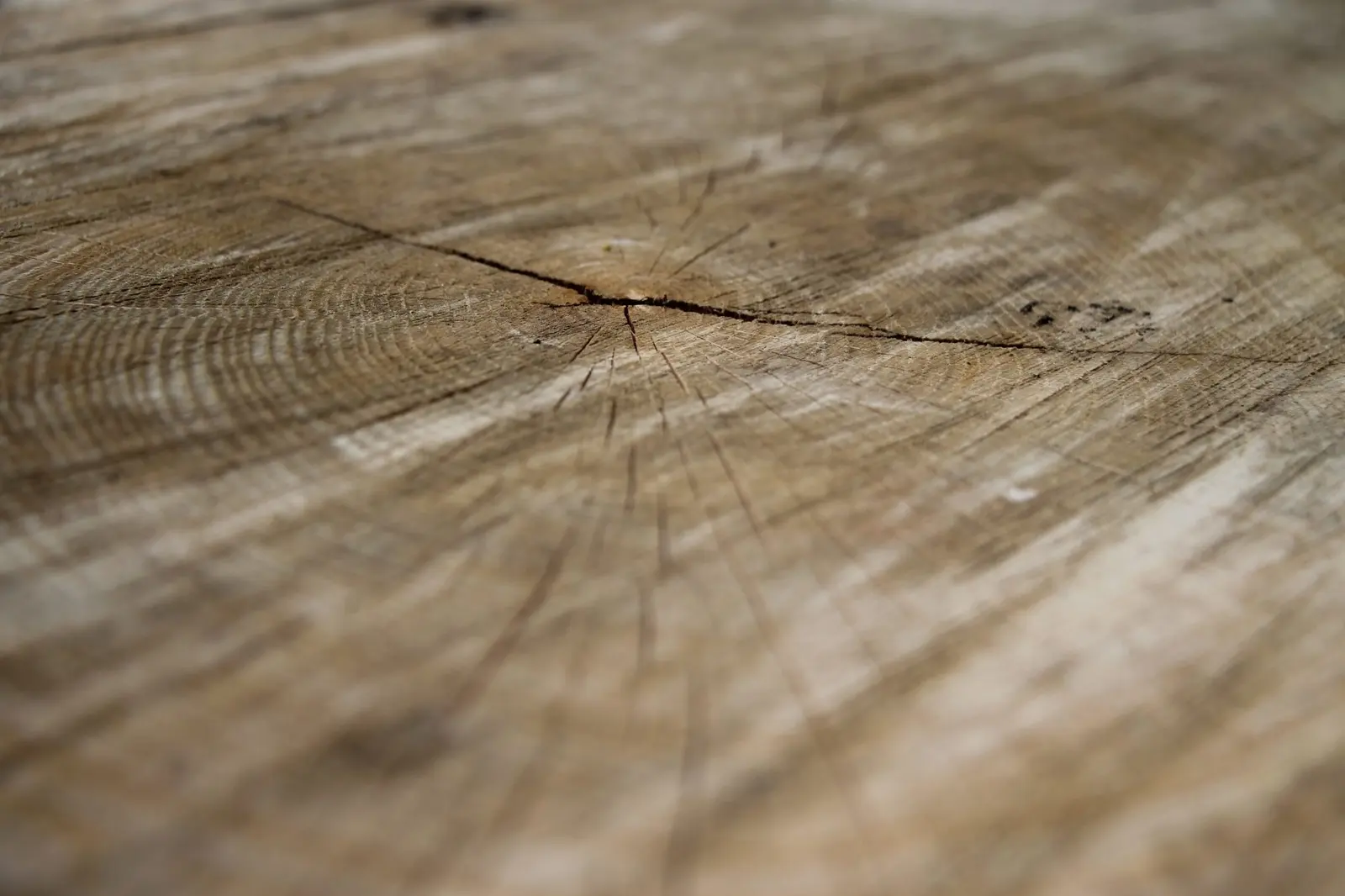
Every board remembers being a tree. The rings in the photograph above are a record — wet springs, dry summers, a fast decade, a slow one — and that record decides how the wood will behave for the next hundred years: how it moves with the seasons, where it wants to crack, and how it takes a finish.
A maker reads this before cutting. A good buyer can learn to read it in a showroom in five minutes. Here is what to look at.
Start at the end grain
The end of a board is its passport. Look at any exposed end — the underside of a tabletop, the bottom of a drawer front:
- Tight, even rings mean slow growth and stable timber. Wide, irregular rings mean fast growth — not bad, but livelier wood that demands better construction around it.
- Ring orientation tells you how the board was cut. Rings meeting the surface at a steep angle (quarter-sawn) move half as much as rings running parallel to it (flat-sawn). Quarter-sawn boards in a tabletop are a quiet sign someone cared.
- Sealed end grain — wax or finish on the ends — shows the maker managed drying, which is where most future cracks are born.
Movement is designed for, not prevented
Solid wood expands and contracts across its width every year of its life. Quality construction never fights this; it makes room for it. Ask, or look:
- Tabletops should be fixed with slotted or button fastenings, never glued or screwed rigidly to the frame.
- Wide panels should sit in grooves, free to float — the panel of a good cabinet door rattles very slightly by design.
- A hairline gap where two boards meet in winter is honesty, not a defect.
The truth about veneer
Veneer is not a lie; bad veneer is a lie. A thick veneer on stable engineered core is the correct choice for large unbroken surfaces — it is why grand pianos are veneered. What you are checking is intent:
Solid wood where the piece takes its knocks — edges, legs, frames. Veneer, if anywhere, on broad protected faces. The reverse order is cost-cutting wearing a costume.
Run a finger under an edge: solid wood is the same material all the way round; cheap veneer reveals a different stripe at the corner.
Five-minute showroom checklist
- Look at end grain: even rings, sealed ends.
- Lift one end of the piece an inch — it should not creak or rack.
- Open a drawer fully: look for dovetails or solid joinery, not staples.
- Find how the top is fixed: room to move, or rigid screws into solid wood (a future crack).
- Ask what the finish is. "Oil" and "hardwax" mean repairable; "we're not sure" means walk slower.
A piece that passes these five is built by people who read the grain. It will still be reading the seasons long after the receipt has faded.